The Vietnamese Magazine
No Result
View All Result
  • Sign in
  • News
    • Vietnam Briefing
  • Politics
  • Human Rights
  • Opinion-Section
  • Society
  • Economy
  • About Us
SUPPORT INDEPENDENT JOURNALISM
  • News
    • Vietnam Briefing
  • Politics
  • Human Rights
  • Opinion-Section
  • Society
  • Economy
  • About Us
No Result
View All Result
The Vietnamese Magazine
No Result
View All Result
Home International Relations

ASEAN’s Regional Fuel Reserve: Will a Shared Energy Plan Be Enough?

Hải Âu by Hải Âu
2 June 2026
Reading Time: 6 mins read
0
ASEAN’s Regional Fuel Reserve: Will a Shared Energy Plan Be Enough?

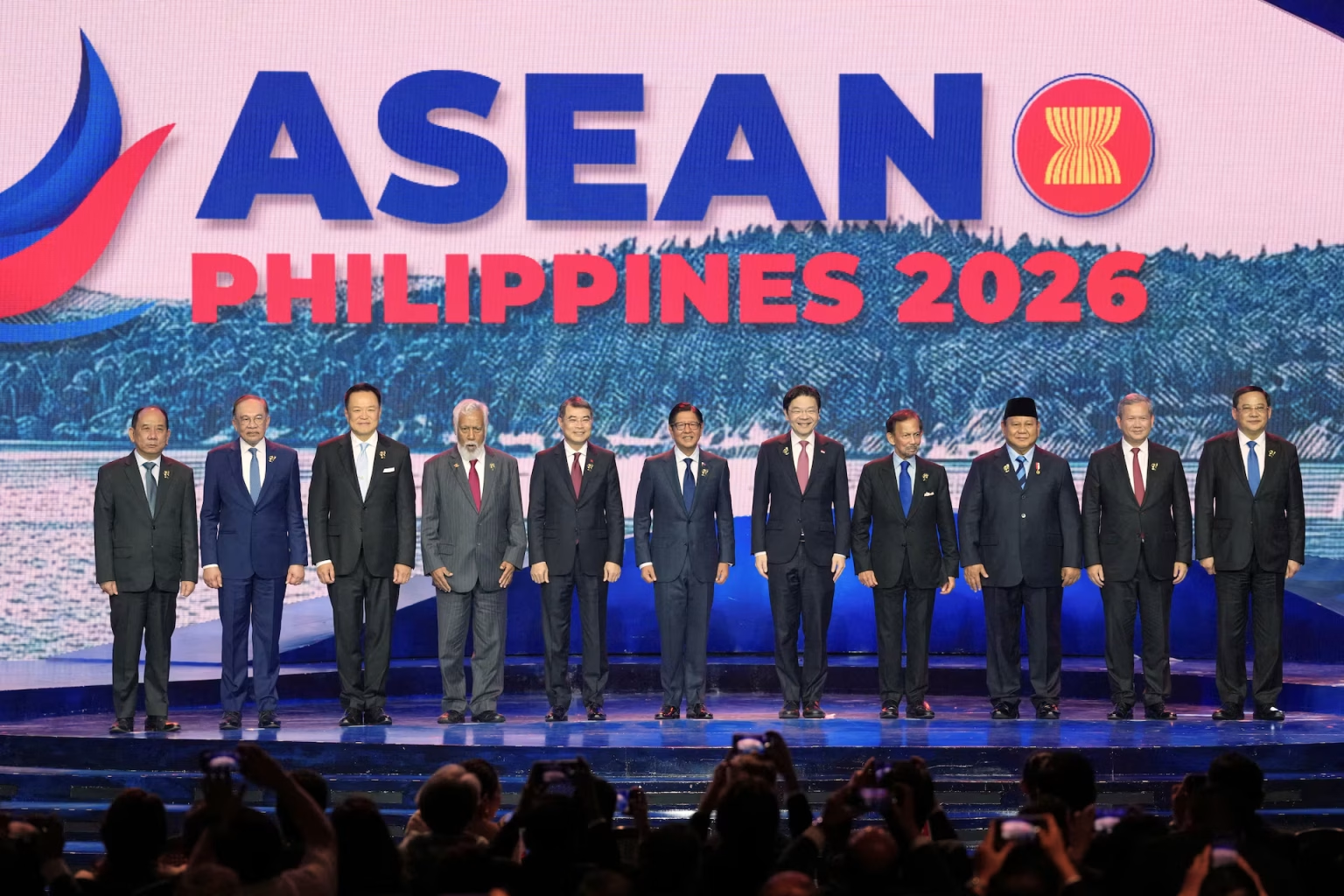
Southeast Asian leaders at the 2026 ASEAN Summit in the Philippines. Photo: Aaron Favila/Reuters.

RELATED POSTS

Việt Nam, Indonesia, and the Board of Peace Amidst the Iran War

The Donald Trump Administration And Trade Risks For Southeast Asia

Why the SEA Games Fail to Professionalize

In response to increasingly severe shocks, Southeast Asian leaders are rushing to develop a shared regional fuel reserve to cushion the impact of surging oil prices during crises. This move reflects a growing recognition within ASEAN that collective action is necessary. 

For the proposal to be effective, ASEAN must overcome its history of slow action and voluntary mechanisms. The bloc must also resolve technical questions regarding reserve governance, contributions, distribution, and prioritization. Fuel stockpiles are only one part of a comprehensive strategy; ASEAN must also diversify its supply sources and accelerate its energy transition.

Responding to Instability

The Association of Southeast Asian Nations (ASEAN) is confronting a series of severe shocks, including prolonged conflict involving Iran, instability across Middle Eastern shipping routes, rising energy prices, and shortages of fertilizer and food supplies. Because these disruptions could seriously affect the daily lives of nearly 700 million people across the region, adaptation during crises is becoming more necessary than ever. [1]

Philippine President Ferdinand Marcos Jr., this year’s rotating ASEAN chair, has called on member states to pursue “practical cooperation” in an increasingly unstable world. At the 48th ASEAN Summit in Cebu, Marcos stressed: “In times of increasing uncertainty, ASEAN must strengthen coordination and enhance preparedness, [and] pursue practical collective measures to ensure stable energy supplies and improve connectivity.” [2]

To support this objective, Southeast Asian leaders proposed the creation of a regional fuel reserve and a contingency mechanism for food security. This proposal carries significant strategic weight as the Strait of Hormuz—a critical route for global oil and gas flows—faces ongoing disruptions. 

Because Southeast Asian countries rely heavily on imported fuel, the region remains particularly vulnerable. Any prolonged closure of the strait would place severe pressure on energy and fertilizer supplies, driving up prices and threatening livelihoods.

Shop and Support Independent Journalism
ADVERTISEMENT

Addressing these realities, Marcos declared: “Our task is to ensure that ASEAN continues to strengthen and expand intra-ASEAN trade while building the capacity to protect and reinforce our food systems across the region.” [3]

Acknowledging the Crisis, Yet Stalling on Solutions

These efforts are not without precedent, as ASEAN has attempted similar initiatives before. Since 1986, the bloc has maintained an oil security agreement, though it is widely regarded as outdated.

According to one ASEAN official, a major limitation was that “it defined an oil crisis only when a country experienced a shortfall of at least 20% of total domestic consumption.” [4]

To update this framework, energy ministers from the 10 ASEAN member states adopted a draft “ASEAN Petroleum Security Agreement” (APSA) in 2008. The APSA aimed to allow “oil-importing members to purchase oil from oil-exporting members at ‘friendly prices’ during emergencies and periods of oil shortages.” [5] 

It also proposed coordinated emergency response measures, under which member states would “endeavor” to provide struggling countries with oil equivalent to 10% of their normal domestic demand on a voluntary and commercial basis. [6]

Despite these early drafts, ASEAN member states have only accelerated efforts to finalize the agreement when energy security directly threatened their development goals.

Currently, the bloc is seeking “to establish an intra-ASEAN fuel-sharing mechanism capable of responding promptly when a member faces severe shortages.” [7] 

The period from 2008 to 2026 remains an exceptionally long time to build an institutional framework for a common emergency response mechanism.

Is a Shared Fuel Reserve Enough?

Historically, ASEAN has faced criticism for being an ineffective “talk shop,” where leaders gather annually in traditional attire for symbolic handshakes that project unity despite deep divisions. [8] 

These limitations stem from an outdated operational structure. Because ASEAN lacks a centralized oil reserve with binding distribution authority, its crisis-response mechanisms rely on voluntarism, flexibility, and the avoidance of excessive obligations. 

As a result, the bloc’s crisis response capacity remains dangerously dependent on political goodwill, logistical capabilities, and the preparedness of individual member states.

In this context, the proposal for a shared fuel reserve represents a significant change. It demonstrates that ASEAN is becoming more conscious of crises and the survival risks facing its members, acknowledging that isolated responses are no longer sufficient. 

Marcos described the mechanism as a regional “pool” of various fuels that members could share during emergencies. [9]

However, this reserve will only be effective if ASEAN can swiftly resolve major technical questions. The bloc must determine how member contributions will be calculated, where reserves will be located, and which countries will receive priority during simultaneous shortages.

Furthermore, it remains unclear whether private companies will participate or if governments will actually share reserves while facing domestic political pressure from rising fuel prices.

ASEAN cannot treat fuel stockpiles as a standalone, long-term solution. While oil reserves are an important tool for mitigating disruptions, Southeast Asia’s current mechanisms may not withstand prolonged crises. 

Hence, ASEAN must deepen international cooperation to pursue oil-sharing arrangements with Asian partners such as China, South Korea, and Japan, while combining emergency reserves with supply diversification and aggressive energy transition strategies.

***
ASEAN now has the opportunity to transform “practical cooperation” into a true driving force for regional cohesion. By doing so, it can demonstrate that the organization is more than just a forum that “talks more than it acts” and suffers from “a lack of effective leadership,” as some scholars have argued. [10]

The success of this initiative depends on ASEAN’s ability to establish a mechanism that is sufficiently transparent, fast, and credible for member states to use during emergencies. If it fails, the bloc risks remaining trapped in its historical cycle of ambitious declarations followed by sluggish implementation.


Hải Âu wrote this article in Vietnamese and published it in Luật Khoa Magazine on May 14, 2026. Đàm Vĩnh Hằng translated it into English for The Vietnamese Magazine.

  1. Khang, D. (2026, May 8). Prime Minister Lê Minh Hưng attends the 48th ASEAN Summit: Việt Nam’s voice is increasingly influential. Pháp Luật Newspaper. https://plo.vn/thu-tuong-le-minh-hung-tham-du-hoi-nghi-cap-cao-asean-lan-thu-48-tieng-noi-cua-viet-nam-ngay-cang-co-do-lan-toa-lon-post907399.html
  2. Mahmud, A. H. (2026, May 6). ASEAN mulls sharing fuel, food resources as fears of prolonged disruptions grow. CNA. https://www.channelnewsasia.com/asia/asean-summit-energy-food-security-stockpile-6109526 
  3. See [2].
  4. P.A. (2008, August 8). ASEAN: Oil security agreement. Sài Gòn Giải Phóng Online. https://www.sggp.org.vn/asean-thoa-thuan-an-ninh-dau-mo-post95468.html
  5. Notable international events of the week, August 4–10, 2008. (2008, August 11). Communist Review. https://tapchicongsan.org.vn/web/guest/hoat-ong-cua-lanh-ao-ang-nha-nuoc/-/2018/6102/nhung-su-kien-quoc-te-dang-chu-y-trong-tuan-%28tu-4-8-den-10-8-2008%29.aspx
  6. ASEAN. (1986). BRUNEI DARUSSALAM, INDONESIA, MALAYSIA, PHILIPPINES, SINGAPORE, THAILAND: ASEAN Petroleum Security Agreement (APSA) 1986. https://policy.asiapacificenergy.org/node/2356 
  7. Tâm, H. T. (2026, March 26). ASEAN: Turning crisis into a driving force for integration. The World and Vietnam Report. https://baoquocte.vn/asean-bien-khung-hoang-thanh-dong-luc-lien-ket-373565.html#google_vignette
  8. Alarmed ASEAN leaders discuss crisis plan to mitigate backlash from Middle East war. (2026, May 8). The Asahi Shimbun. https://www.asahi.com/ajw/articles/16550456 
  9. See [2]
  10. ASEAN At A Crossroads: From Talk Shop To True Regional Power. (2025, October 23). INS. https://www.theins.news/postview/2869-asean-at-a-crossroads-from-talk-shop-to-true-regional-power

Like this:

Like Loading…
Tags: ASEANFuel Reserve
Hải Âu

Hải Âu

Related Posts

No Content Available
Next Post
Đồng Tâm Land Dispute Referenced in Red River Group Chat, Swiftly Deleted

Đồng Tâm Land Dispute Referenced in Red River Group Chat, Swiftly Deleted

Hà Nội Red River Project: Residents Press Lawmakers to Intervene on Land Clearance 

Hà Nội Red River Project: Residents Press Lawmakers to Intervene on Land Clearance 

Leave a ReplyCancel reply

OPINIONS

Why Stories Like the Red River Project Prove the World Still Needs Journalists Who Won’t Be Silenced

Why Stories Like the Red River Project Prove the World Still Needs Journalists Who Won’t Be Silenced

2 June 2026
Việt Nam’s 83% Satisfaction Index: Encouraging or Suspicious?

Việt Nam’s 83% Satisfaction Index: Encouraging or Suspicious?

28 May 2026
​Child Abuse in Việt Nam: Where Is the Vietnam Association for Protection of Child Rights?

​Child Abuse in Việt Nam: Where Is the Vietnam Association for Protection of Child Rights?

27 May 2026

POPULAR STORIES

  • Religion Bulletin – March 2026 – USCIRF Says Việt Nam Is Intensifying Crackdown on Independent Religious Groups as Bàni Followers Resist Renaming Effort

    Religion Bulletin – April 2026 – Việt Nam Passes Amended Religion Law As Authorities Prosecute Four Independent Protestants

    0 shares
    Share 0 Tweet 0
  • The Strait of Hormuz Crisis: How Việt Nam is Handling the 2026 Global Oil Shock

    0 shares
    Share 0 Tweet 0
  • Post-1975 Tragedy: The Grim Reality of Life in Vietnam’s Re-education Camps

    0 shares
    Share 0 Tweet 0
  • Memory in Print: The Death and Resurrection of South Vietnamese Literature

    0 shares
    Share 0 Tweet 0
  • The Forgotten German Veterans of Việt Nam

    0 shares
    Share 0 Tweet 0
Facebook Twitter LinkedIn
The Vietnamese Magazine

Published since 2017 by Legal Initiatives for Vietnam — a 501(c)(3) nonprofit media organization.

U.S. Office: Legal Initiatives for Vietnam, 1520 E. Covell Suite B5 – 426, Davis, California, United States 95616

Taiwan Office: 美國法治越南台灣分部, 4th Floor, RIIC Building, National Chengchi University, No. 64, Sec. 2, Zhinan Rd., Wenshan Dist., Taipei City, Taiwan (ROC) 116

editor@thevietnamese.org

  • The Vietnamese’s Story
  • Submission
  • Sign in
No Result
View All Result
  • Sign in

This website uses cookies. By continuing to use this website you are giving consent to cookies being used. Visit our Privacy and Cookie Policy.

Discover more from The Vietnamese Magazine

Subscribe now to keep reading and get access to the full archive.

Continue reading

%d