


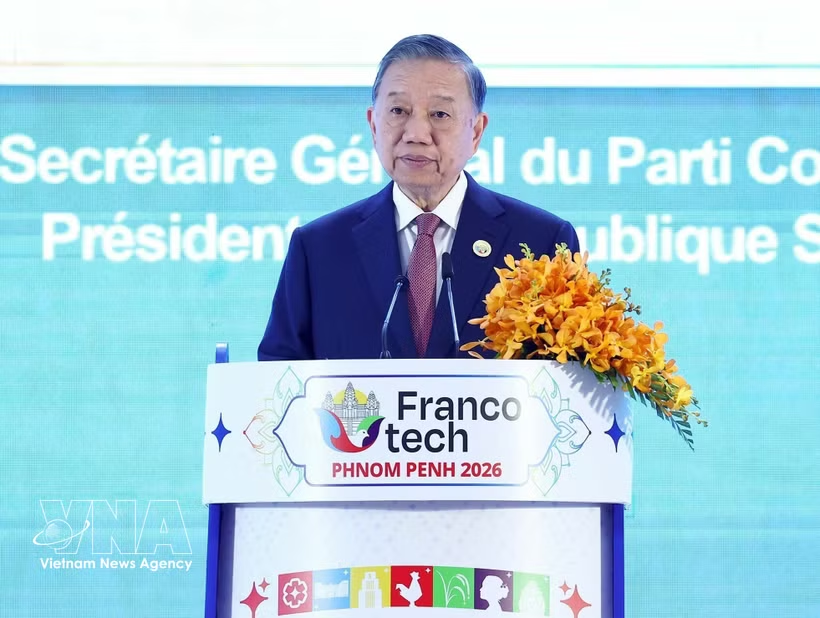
On Nov. 16, General Secretary of the Communist Party of Vietnam and State President Tô Lâm addressed the plenary roundtable of the 20th Francophonie Summit in Phnom Penh. Speaking under the theme “Reinvest in Peace for Shared Prosperity and Lasting Stability,” he called for greater international solidarity, conflict prevention, and respect for international law.
The Vietnamese leader also outlined three priorities for the Francophone community: strengthening dialogue and preventing conflicts, investing in human capital, and expanding economic and technological cooperation between member states.
However, the diplomatic setting carried an uncomfortable contradiction. Only two months earlier, two Vietnamese human rights activists holding Norwegian and Australian citizenship disappeared while visiting Cambodia.
Vietnamese authorities subsequently announced that they had arrested the men near the border and charged them with terrorism—a claim that human rights organizations have challenged, raising serious concerns that the men were abducted on Cambodian territory and forcibly transferred to Việt Nam.
The case is particularly sensitive given Tô Lâm’s political background as the former head of Việt Nam’s Ministry of Public Security and his longstanding relationship with Cambodia’s political leadership.
For a leader advocating peace, dialogue, and international law, the events surrounding the summit exposed a fundamental question: how can Việt Nam promote these principles internationally while its security apparatus is accused of extending political repression beyond its borders?
A Diplomatic Showcase for Hà Nội
Việt Nam’s participation in the Francophonie is rooted in a relationship that predates its contemporary diplomatic strategy. Having joined the International Organisation of La Francophonie (OIF) in 1970 and hosted its seventh summit in Hà Nội in 1997, the country used the summit’s return to Southeast Asia—this time in Cambodia— to reaffirm its engagement with a community extending across Europe, Africa, and the Asia-Pacific.
For Tô Lâm, the event also served to reinforce Việt Nam’s international visibility and strengthen its diplomatic relationships beyond its immediate neighborhood. He placed his primary emphasis on economic cooperation, reflecting Hà Nội’s broader ambition to attract foreign investment and develop strategic industries, such as semiconductors, renewable energy, and advanced technologies.
On Nov. 16, he met French President Emmanuel Macron to discuss the implementation of the Comprehensive Strategic Partnership established in October 2024. According to the Vietnamese government’s account of the meeting, both leaders agreed to strengthen defense and security cooperation and advance strategic projects involving Earth-observation satellites, urban railways, and renewable energy.
France also welcomed Việt Nam’s proposal to promote dialogue on peace and security between Francophone member states and regional organizations.
However, the meeting also unfolded in a context where questions surrounding Việt Nam’s human rights record have become increasingly difficult for European governments to ignore.
The Security Dimension of a Close Relationship
On Nov. 14, ahead of the official opening ceremony, the Vietnamese leader met Hun Sen, president of the Cambodian People’s Party (CPP) and president of the Senate. Despite transferring the premiership to his son, Hun Manet, in 2023, Hun Sen remains one of Cambodia’s most influential political figures. According to the Vietnamese government’s account, Tô Lâm described him as a close and longstanding friend of the Communist Party, the state, and the people of Việt Nam.
During the meeting, both sides committed to strengthening cooperation in maintaining political stability, social order, and security along their shared border, as well as combating transnational crime—including cybercrime. But this agreement clearly raises questions about the safeguards of human rights defenders and advocates seeking to leave these countries for their safety.
The disappearance of Nguyễn Đức Thuận and Trần Hiệp, the two Vietnamese activists with foreign citizenship, makes this dimension particularly sensitive. While there is no publicly established evidence that Hun Sen personally authorized or participated in their disappearance—nor has an official investigation established Cambodian state involvement—the case has exposed serious inconsistencies between the accounts provided by the two governments. It has also raised questions about the circumstances under which Vietnamese citizens and activists can be detained and transferred across borders.
At its core, the issue is whether this relationship also creates an environment in which political dissidents can be pursued beyond their national borders without legal process.
A Summit Held Under an Uncomfortable Political Climate
Although Phnom Penh hosted dozens of international delegations, Cambodian human rights organizations and opposition figures used the event to draw attention to the country’s deteriorating democratic conditions.
Ahead of the summit, a coalition of 26 civil society organizations submitted an open letter to the French and Canadian embassies, urging participating governments to address restrictions on political freedoms, attacks against independent civil society, and the detention of activists.
Outside the French embassy, security guards blocked approximately 70 demonstrators attempting to protest, though they still managed to submit a petition demanding the release of political prisoners.
The demonstrations unfolded as Tom Andrews, the United Nations Special Rapporteur on the situation of human rights in Cambodia, called on the government to release more than 100 individuals reportedly detained for exercising fundamental freedoms, including freedom of expression, peaceful assembly, and association.
In its Nov. 13 report, UCA News documented the pre-summit campaign that Cambodian activists organized. Meanwhile, exiled opposition figure Sam Rainsy described the summit as being “at the wrong place at the wrong time,” arguing that Cambodia’s political environment contradicted the values promoted by the Francophonie.
Cambodia has also become an increasingly important country in discussions surrounding transnational repression in Southeast Asia. For many Vietnamese, it had previously represented a possible refuge from political persecution at home; its proximity and the presence of Vietnamese-speaking communities made it an accessible destination for activists and individuals seeking to avoid arrest.
However, the disappearance of Nguyễn Đức Thuận and Trần Hiệp has illustrated just how precarious that protection is becoming.
The Disappearance of Nguyễn Đức Thuận and Trần Hiệp
On Sept. 15, 2026, Nguyễn Đức Thuận, a 52-year-old Vietnamese-Norwegian human rights activist based in Oslo, and Trần Hiệp, a 51-year-old Vietnamese Australian activist from Melbourne, travelled from Bangkok to Phnom Penh. Both men were members of Việt Tân, an overseas political organization advocating for democratic change in Việt Nam. Their families and colleagues remained in regular contact with them until the morning of Sept. 18, when communication suddenly stopped.
The men were expected to return to Bangkok on Sept. 19 but never boarded their scheduled flight. After their families raised concerns about their disappearance, authorities reportedly found their luggage and other personal belongings in their hotel rooms.
On Sept. 25, Việt Tân publicly announced that the two men had gone missing and called on the Australian and Norwegian governments to help establish their whereabouts.
Three days later, Việt Nam’s Ministry of Public Security announced that Nguyễn Đức Thuận, Hồ Phạm Hiệp Huy (also known as Trần Hiệp), and Thái Công Trường Sơn, a third Vietnamese national, had been arrested at the Mỹ Quý Tây border crossing in Tây Ninh Province on Sept. 18.
According to the official statement, the three men had attempted to enter Việt Nam illegally from Cambodia using forged documents. Authorities alleged that Thuận possessed two counterfeit Vietnamese identity cards, while Hiệp was carrying an Australian passport under his name. The police further stated that the three had confessed to being members of Việt Tân and intending to conduct terrorist and sabotage activities in Việt Nam.
They were formally charged under Article 299(2) of the Penal Code, concerning terrorism, and Article 341(2), concerning the forgery of official documents.
In its Oct. 13 statement, Human Rights Watch called for the immediate release of all three men, arguing that their apparent abduction and detention raised serious questions about the involvement of both governments. The organization also highlighted a significant geographical discrepancy: the men’s last known communication reportedly took place in Kaoh Andaet District, in Cambodia’s Takeo Province, more than 250 kilometers from the Mỹ Quý Tây border crossing, where Vietnamese authorities claim they were arrested.
The discrepancy has raised concerns that the activists may have been forcibly transferred into Việt Nam without any formal extradition or legal procedure.
Cambodian authorities have denied involvement in their detention or transfer. In a statement issued on Oct. 7, the Ministry of Interior said its immigration records indicated that the two men had entered Cambodia on Sept. 15 but contained no record of their departure. However, it categorically rejected allegations that Cambodian officials had arrested and handed them over.
The Cambodian government’s account has not resolved the central questions surrounding their disappearance.
According to the International Federation for Human Rights (FIDH), both men were subsequently identified as being held at Chí Hòa Prison in Hồ Chí Minh City. The organization also highlighted concerns about the health of Nguyễn Đức Thuận, who requires daily insulin injections and medical attention for kidney problems.
The irony was difficult to overlook: while international leaders gathered in Phnom Penh to discuss peace, questions remained unanswered about the fate of the activists who had disappeared inside the country.
- Tô Lâm, “Full Remarks by General Secretary, President To Lam at Plenary Roundtable of 20th Francophonie Summit,” Viet Nam Government News, November 16, 2026, https://en.baochinhphu.vn/full-remarks-by-general-secretary-president-to-lam-at-plenary-roundtable-of-20th-francophonie-summits-111261116141105165.htm.
- Organisation internationale de la Francophonie, “Viet Nam,” accessed November 19, 2026, https://www.francophonie.org/node/991.
- Conférence des chefs d’État et de gouvernement des pays ayant le français en partage, “Déclaration de Hanoi” [Hanoi Declaration], VIIe Sommet de la Francophonie, Hanoi, November 14–16, 1997, PDF, Organisation internationale de la Francophonie, https://www.francophonie.org/sites/default/files/2019-10/Declaration_SOM_VII_16111997.pdf.
- Huong Giang, “To Lam Meets French President Emmanuel Macron in Cambodia,” Viet Nam Government News, November 16, 2026, https://en.baochinhphu.vn/to-lam-meets-french-president-emmanuel-macron-in-cambodia-111261116143207135.htm.
- Quang Minh, “Top Vietnamese Leader Meets Cambodian People’s Party President Hun Sen,” Viet Nam Government News, November 15, 2026, https://en.baochinhphu.vn/top-vietnamese-leader-meets-cambodian-peoples-party-president-hun-sen-111261115093151741.htm.
- “Cambodian Activists Up the Ante as Francophone Leaders Fly In for Summit,” UCA News, November 13, 2026, https://www.ucanews.com/news/cambodian-activists-up-ante-as-francophone-leaders-fly-in-for-summit/116217.
- Poppy McPherson, “Exiled Cambodian Politician Denounces Francophonie Summit, Citing Repression,” Reuters, published in Miami Herald, November 13, 2026, https://www.miamiherald.com/news/nation-world/world/article318060424.html.
- Human Rights Watch, “Vietnam: Free Abducted Democracy Group Activists,” news release, October 13, 2026, https://www.hrw.org/news/2026/10/13/vietnam-free-abducted-democracy-group-activists.
- C. Nika, “Cambodia Says It Did Not Arrest, Hand Over Australian and Norwegian Nationals to Vietnam,” Agence Kampuchea Presse, October 8, 2026, https://v2.akp.gov.kh/post/detail/383369.
- Observatory for the Protection of Human Rights Defenders (FIDH–OMCT), “Vietnam/Cambodia: Human Rights Defenders Nguyen Duc Thuan, Hiep Tran and Thai Cong Truong Son Charged with Terrorism in Vietnam after Their Enforced Disappearance in Cambodia,” urgent appeal VNM 001 / 1026 / OBS 050, FIDH, October 13, 2026, https://www.fidh.org/en/issues/human-rights-defenders/vietnam-cambodia-human-rights-defenders-nguyen-duc-thuan-hiep-tran.


Join the conversation