


Ngọc Hà wrote this article in Vietnamese, published in Luat Khoa Magazine on March 10, 2025.
At a city university just a 30-minute train ride from central London, I noticed a strange phenomenon. The school hosted a large number of Vietnamese students, but their attendance in class was strikingly low. Except for mandatory sessions with attendance checks or exams, they were rarely seen on campus. When I asked why, the answer was always the same: they were working “after hours.”
In reality, “after hours” meant working more than the 20 hours per week permitted under their student visas. The story of H.—a former student at the University of Greenwich, London—is a case in point. She told me that by “working hard” at a Vietnamese-owned nail salon for 36 to 39 hours a week, she could earn between £2,000 and £3,000 a month. It was a figure I found surprisingly high, but one I later realized was accurate after reading a report on the industry by the UK Home Office’s National Careers Service.
This “generous income,” as she called it, allowed her to save money and send remittances home to her family in Việt Nam. After three years of diligent work since arriving in 2017, H. was able to purchase a condominium back home, right when the domestic real estate market had come to a standstill due to the COVID-19 pandemic.
“At Vietnamese-owned nail salons, wages are paid in cash rather than via bank transfer,” H. explained. “That’s a way to bypass the law, evade taxes, and avoid detection by the authorities.”
H.’s story is far from uncommon. Her experience is part of a larger trend of Vietnamese people leaving the country for various purposes—from studying abroad to seeking asylum. For many, like those working long hours in London’s nail salons, it represents the pursuit of a new “British Dream,” a path to economic security that seems out of reach back home.
An Economy on the Rise…
Việt Nam is often considered one of Asia’s emerging “dragons.” According to the International Monetary Fund (IMF), the country’s gross domestic product (GDP) grew by a remarkable 8.1% in 2022 and was projected to stabilize at a steady 6.5% in 2024. The IMF also forecasts that Vietnam’s GDP will further increase by 7% in 2025, a steady growth rate for developing economies.

However, these impressive macroeconomic figures do not mean that the average citizen’s income is sufficient to meet ends. A survey by Anphabe covering 65,000 workers revealed that up to 74% said their incomes did not meet their living expenses. In the third quarter of 2024, the average monthly salary for Vietnamese workers was 7.6 million đồng; however, respondents said they needed at least 11.8 million đồng just to cover basic daily costs.
This wage gap has real-world consequences. State-run newspapers have repeatedly reported that many Vietnamese cannot afford social housing, as real estate prices grow exponentially while salaries increase at the slow pace of “bamboo shoots in the village.”
This financial pressure is compounded by persistently high unemployment rates, painting a grim picture of the economic reality for much of the country’s working class. The highest legal hourly wage in Việt Nam, 22,500 đồng, starkly contrasts with the average of nearly 370,000 đồng per hour for a nail salon job in the UK, highlighting just how far behind domestic wages still are.
… But the People Keep Leaving
To this day, there are no comprehensive statistics detailing how many Vietnamese have migrated to the UK, though the Vietnamese Consulate General estimates the number to be around 100,000, both legally and illegally.
To understand this modern reality, it helps to look at the history. A 2010 study by researchers Silverstone and Savage categorized Vietnamese migration to the UK into three major waves: the first began after the end of the Việt Nam War in 1975 with the “boat people”; the second occurred in the 1990s as migrants from former Soviet bloc countries moved to the UK; and the third wave emerged in the late 2000s, driven by aspirations of wealth and a better life.
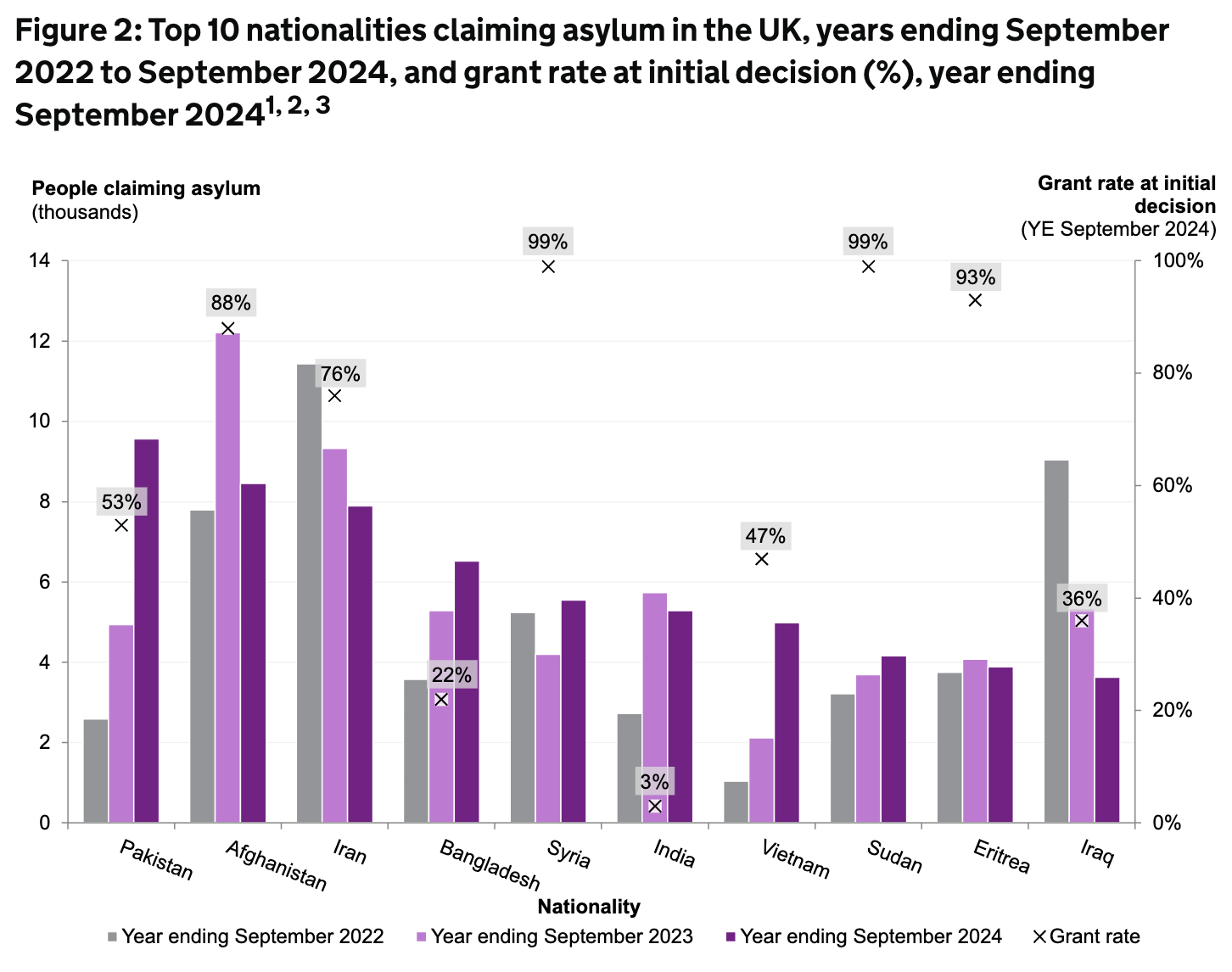
A significant portion of the modern community remains undocumented. As far back as 2001, over 20,000 out of the 55,000 Vietnamese migrants were estimated to have entered illegally. This trend has accelerated dramatically; as of September 2024, the rate of illegal immigration from Việt Nam had surged by 177% compared to the previous year, surpassing the increase from even conflict-ridden countries like Afghanistan.
Another key motivation is seeking asylum. According to the UK Home Office, the proportion of Vietnamese nationals among total asylum applications has surged from 8% in 2022 to 38% in 2024, placing Vietnam 6th on the UK’s top 10 list for successful asylum seekers.
Of the 100,000 Vietnamese in the UK, only about 8,009 are international students, but their story is often intertwined with the economic pressures driving migration. An incident in 2012, where 170 Vietnamese students at London Metropolitan University were nearly deported due to poor class attendance, hinted at the conflict between study and work.
The tragic 2019 deaths of 39 Vietnamese migrants in a refrigerated truck, and subsequent raids on nail salons employing undocumented workers, further exposed this reality. It was only after meeting with many members of the Vietnamese student community in the UK that I began to understand: while gaining knowledge is one goal, for most of them, the ultimate aim is to earn money.
Illegal Migration
As statistics from the UK Home Office show, the number of Vietnamese nationals entering the country illegally has risen sharply. This dangerous journey has had tragic consequences, most notably the 2019 deaths of 39 Vietnamese people found in a refrigerated truck while attempting to reach the UK. Despite such horrors, many still attempt the journey. A report from VietnamPlus in early 2024 detailed the “rescue” of seven more Vietnamese migrants found in a truck upon its arrival at Newhaven Port in Sussex.
According to InfoMigrants, a typical smuggling route for Vietnamese migrants starts overland through Hungary—the only Eastern European country that issues work visas to them. From there, they travel to the northern French coast, particularly the Grande-Synthe and Dunkirk areas, before attempting the final, perilous leg of the journey to the UK.
Once they arrive, a common job for undocumented migrants is cannabis cultivation—a trade that requires no formal education, capital, or specific skills. However, the legal risks are immense. The UK classifies cannabis as a Class B controlled substance; while it can be used for medical purposes, its production is strictly regulated and requires a license from the Home Office.
The penalties for breaking this law are severe: possession alone can lead to up to five years in prison, while those caught supplying or producing cannabis face sentences of up to 14 years, or even life imprisonment.
Việt Nam and the UK Join Forces to Tackle Illegal Migration
In response to this persistent issue, the governments of Việt Nam and the UK have increased their cooperation.
On April 17, 2024, Colonel Vũ Văn Hưng of Việt Nam’s Immigration Department and Michael Tomlinson, the UK’s Minister for Countering Illegal Migration, signed a joint declaration in London. Under the agreement, both countries committed to public awareness campaigns, tightening visa controls, and supporting the repatriation of undocumented migrants. This signing followed a high-level meeting on April 15 between Tô Lâm—then serving as Minister of Public Security—and UK Home Secretary James Cleverly.
For its part, the UK has been stepping up its crackdown with harsher immigration measures. These efforts, ongoing since 2021, have culminated in a new Migration Law that classifies illegal entry as a criminal offense. The penalties include up to four years in prison, along with deportation orders and lifetime bans on reentry. In October 2024, these new powers were put into action with the deportation of 46 individuals, including Vietnamese nationals.
For its part, the UK has been stepping up its crackdown with harsher immigration measures. Public outreach efforts have been ongoing since 2021, and on March 25, 2024, the UK Home Office launched another public campaign specifically to deter illegal boat crossings.
These efforts have culminated in a new Migration Law that classifies illegal entry as a criminal offense, with penalties of up to four years in prison, along with deportation orders and lifetime bans on reentry. In October 2024, these new powers were put into action with the deportation of 46 individuals, including Vietnamese nationals.
Despite these joint efforts and harsh new penalties, the challenge of illegal migration to the UK remains a persistent and unresolved issue.
Whether through legal or illegal channels, whether driven by a thirst for knowledge or the hope of a better life, one truth remains: many Vietnamese still want to leave their homeland.


