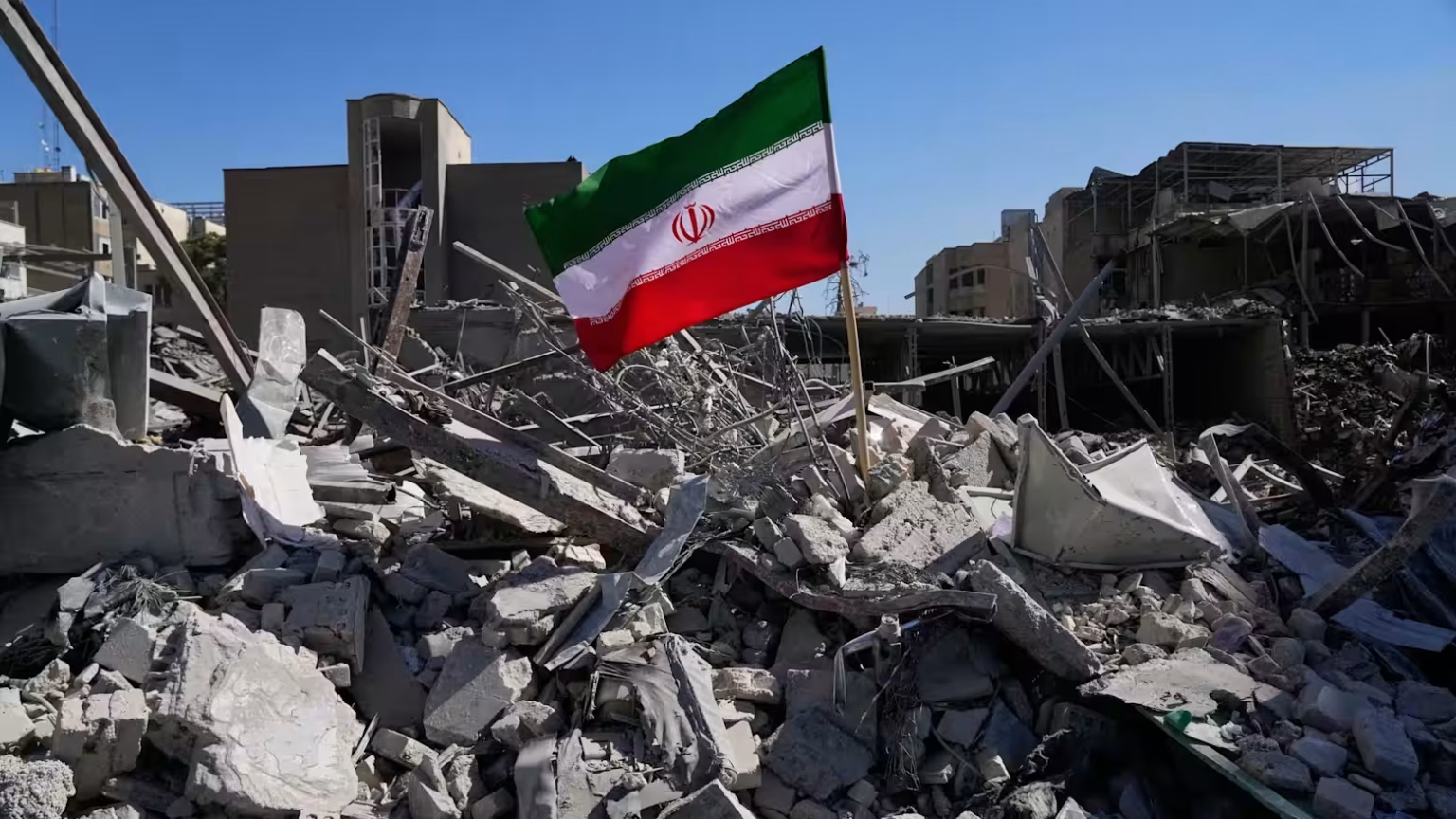
The conflict involving the United States, Israel, and Iran demonstrates how wars taking place thousands of kilometers away can still impact the economic life of Việt Nam. While conflicts in the Middle East are often viewed as distant developments with little direct relevance to daily life at home, geographical distance is no longer an effective shield against geopolitical shocks.
By causing disruptions in air travel, risks to maritime shipping routes, and fluctuations in oil prices linked to the Strait of Hormuz, these tensions quietly exert significant pressure on open economies that depend heavily on trade and imported energy. For Việt Nam, the sectors most affected by this seemingly distant conflict include aviation, energy, and maritime transport.
Air Travel
Disruptions to air transport are one of the most visible effects of the conflict. Following the escalation of tensions, numerous flights transiting through major Middle Eastern hubs were canceled or had their schedules adjusted for security reasons. This situation directly impacts Vietnamese people working or studying in Europe, as they frequently rely on transit airports such as Doha, Dubai, or Abu Dhabi when returning to Việt Nam.
While these disruptions may be temporary, they demonstrate how security conflicts quickly spill over into daily life, particularly within transportation and tourism. Although airlines have rerouted flights to avoid the immediate conflict zone, domestic media reports that “the Middle East conflict has seriously affected Việt Nam’s aviation industry, reducing demand for tourism and trade while disrupting supply chains.” [1]
Consequently, air transport, commerce, and tourism continue to face ongoing disruptions as the crisis remains complicated.
Energy

However, the energy sector is likely to experience more significant effects. Because the Middle East has long been the central hub of the global oil market, any instability there has the potential to trigger shocks in energy prices.
A particularly sensitive point is the Strait of Hormuz, the strategic maritime passage that connects the Persian Gulf with the Indian Ocean. [2] Around 20 percent of the world’s traded oil passes through this route every day, most of it destined for Asian economies. [3] If Iran attempts to exert pressure by threatening or restricting traffic through Hormuz, the global oil market could quickly fall into turmoil.
Although Việt Nam was once an exporter of crude oil, the country has become increasingly dependent on imported petroleum products to meet domestic demand. [4] Rapid economic growth has led to steadily rising energy consumption, while domestic refining capacity remains limited, making domestic fuel prices particularly sensitive to fluctuations in international markets.
Amid the complicated situation, on March 4, Prime Minister Phạm Minh Chính issued Decision No. 385/QĐ-TTg, establishing a “task force to ensure energy security amid the complicated developments of the conflict in the Middle East.” [5] Furthermore, the Ministry of Industry and Trade has also formed a specialized task force to closely monitor the situation, proactively respond to developments in the Middle East conflict, and ensure stable fuel supplies. [6] These responses are necessary at a time when global energy markets are increasingly vulnerable to geopolitical shocks.
In the past, energy crises have had widespread effects across Việt Nam’s economy. When oil prices surge, transportation and production costs usually rise as well, pushing inflation higher. These energy shocks can quickly spread into higher prices for food, consumer goods, and logistics. Moreover, as Việt Nam is an export-oriented economy with supply chains deeply integrated into global trade, fluctuations in fuel prices can directly affect the competitiveness of its businesses. [7]
Maritime Transport
Beyond oil prices, tensions in the Middle East may also affect maritime shipping routes, as the Persian Gulf region is both a center of oil production and a key hub of global trade.
When geopolitical risks increase, insurance costs for cargo vessels typically rise, which immediately drives up the cost of shipping goods. Furthermore, even the perception that a conflict may escalate can be enough for shipping companies to alter their routes or impose additional insurance surcharges.
For an export-dependent economy like Việt Nam, these changes in maritime transport costs can quickly affect trade. This is particularly significant because most of Việt Nam’s exports, ranging from electronics to textiles, are transported to Europe and the Middle East via international shipping routes linking the Indian Ocean and the Mediterranean.
If these passages become riskier or more expensive, exporting firms will face higher logistics costs at a time when their profit margins are already relatively thin.
***
In short, the effects of conflicts in the Middle East quickly spread into other sectors through direct impacts on energy markets, transportation, and finance.
For an open economy striving for deeper integration into global markets like Việt Nam, the consequences of these geopolitical tensions may be long-lasting. As seen in recent days, a war taking place thousands of kilometers away can still push domestic fuel prices sharply higher [8] and drive up the cost of transporting goods.
Furthermore, this calculation does not even account for the quieter but equally painful consequences, such as how the journey home for Vietnamese workers abroad is becoming increasingly difficult.
Lý Tấn Tài wrote this article in Vietnamese and published it in Luật Khoa Magazine on March 09, 2026. Đàm Vĩnh Hằng translated it into English for The Vietnamese Magazine.
- Duy, P. (2026, March 7). Xung đột ở Trung Đông, các hãng hàng không Việt khai thác chặng bay này thế nào? CafeF. https://cafef.vn/xung-dot-o-trung-dong-cac-hang-hang-khong-viet-khai-thac-chang-bay-nay-the-nao-188260307130845329.chn
- Thủy, H. (2026, March 3). ‘Nút thắt cổ chai’ mang tên Eo biển Hormuz. Thông tấn xã Việt Nam. https://baotintuc.vn/phan-tichnhan-dinh/nut-that-co-chai-mang-ten-eo-bien-hormuz-20260303113517184.htm
- IRGC says Iran in ‘complete control’ of Strait of Hormuz amid Trump threats. (2026, March 4). Al Jazeera. https://www.aljazeera.com/news/2026/3/4/irgc-says-iran-in-complete-control-of-strait-of-hormuz-amid-trump-threats
- Hằng, P. (2026, March 7). Nhà máy lọc dầu Dung Quất và Nghi Sơn: Hai “mắt xích” then chốt trong bài toán năng lượng Việt Nam. Viet Times. https://viettimes.vn/nha-may-loc-dau-dung-quat-va-nghi-son-hai-mat-xich-then-chot-trong-bai-toan-nang-luong-viet-nam-post195334.html
- Thành lập Tổ công tác bảo đảm an ninh năng lượng trước diễn biến phức tạp tại Trung Đông. (2026, March 5). Báo Điện tử Chính phủ. https://baochinhphu.vn/thanh-lap-to-cong-tac-bao-dam-an-ninh-nang-luong-truoc-dien-bien-phuc-tap-tai-trung-dong-102260305093635715.htm
- Trúc, M. (2026, March 5). Thành lập Tổ công tác bảo đảm an ninh năng lượng trước diễn biến xung đột Trung Đông. Pháp Luật. https://plo.vn/thanh-lap-to-cong-tac-bao-dam-an-ninh-nang-luong-truoc-dien-bien-xung-dot-trung-dong-post898116.html
- Mai, H. (2026, March 1). Việt Nam ‘bùng nổ’ trên truyền thông quốc tế. Thanh Niên. https://thanhnien.vn/viet-nam-bung-no-tren-truyen-thong-quoc-te-185260228221235512.htm
- Vy, H. (2026, March 7). Bối cảnh thế giới bất ổn, giá xăng dầu trong nước đồng loạt tăng “phi mã”. VnEconomy. https://vneconomy.vn/boi-canh-the-gioi-bat-on-gia-xang-dau-trong-nuoc-dong-loat-tang-phi-ma.htm