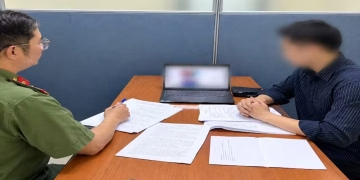
Việt Nam’s state broadcaster, VTV4, has criticized independent media, accusing them of deploying “gray propaganda” and psychological manipulation to undermine the public’s trust in the socialist regime.
The Latest: On July 9, VTV4 faced significant online engagement following a segment that accused independent media of using “gray propaganda.”
- As of noon on July 9, the broadcast had generated more than 3,800 interactions on social media; however, VTV4 proceeded to hide all 126 comments under the post.
- On the afternoon of July 9, Luật Khoa Magazine emailed VTV4 seeking more information but had yet to receive a response.
The Details: In an interview on the VTV4 program “View From Hà Nội,” Nguyễn Minh Tâm, former director of the Center for Scientific Information and Textbook Documentation under the People’s Public Security Political Academy, stated that “with the success of the socialist state of Vietnam after 40 years of Đổi Mới,” “hostile reactionary forces” can no longer rely on “dark propaganda.”
- Tâm explained that this former method involved “darkening an issue, darkening a phenomenon, and darkening an event.”
According to Tâm, the new tactic involves “psychological manipulation.”
- “They exploit a method we often call ‘green outside, red inside.’ On the surface, it seems to praise and appears reasonable, but in essence it embeds distorted narratives and arguments that steer listeners and viewers toward the purposes they want, leading readers and viewers not to trust the regime or reforms,” Tâm said.
- He added, “Attacking people’s trust. That is their goal.”
Tâm further elaborated that “the most common tactic now is “gray propaganda,” meaning it is as murky as clam broth, wherein the cloudy water contains both truth and falsehood, half fake and half real, seven parts fake and three parts true.”
During the report, VTV4 displayed screenshots of independent news sites as examples, marked with red crosses and blurred. The targeted articles included “Vietnam’s Economy in the First Four Months of 2026: Macroeconomic Growth, but People’s Livelihoods Remain Very Difficult” by Việt Tân; “Redefining Growth: From ‘GDP Intoxication’ to Discipline, Efficiency and Lasting Value” on Bauxite Việt Nam; and “Searching for a Socialist Model for Vietnam’s Wards and Communes, Part 2” on Tiếng Dân.
- It remains unclear which specific parts of these articles VTV4 and Tâm believe constitute “steering,” “leading,” “seven parts fake and three parts true,” or “psychological manipulation” designed to make readers’ trust “waver.”
The Background: On June 24, VTV4 posted a report on Facebook titled “What Is the Purpose Behind Distorted Narratives About Press Freedom in Vietnam?”
- The broadcast claimed that some “ill-intentioned” news sites utilized the World Press Freedom Index by Reporters Without Borders (RSF) to “organize reactionary activities” and “smear Vietnamese journalism.”
- Users were unable to read the more than 200 comments left under that post.
2026 Press Freedom Index: The RSF 2026 World Press Freedom Index, released on the morning of April 30 during a press conference in Taipei, Taiwan, assessed conditions from 2025.
- Although released in 2026, the index is part of RSF’s annual ranking program, which the organization has conducted since 2002.
- In the 2026 index, Việt Nam rose 1.5 points to 21.15 out of 100 but dropped one place to 174th out of 180 countries.
With this result, Việt Nam continued its tradition of ranking near the bottom of the press freedom index, alongside Eritrea at 180, North Korea at 179, China at 178, Iran at 177, Saudi Arabia at 176, and Afghanistan at 175.
- In its report on Việt Nam, the French NGO wrote: “Vietnam’s traditional media are tightly controlled by a single political party. Independent journalists and bloggers are frequently imprisoned, making Vietnam one of the world’s largest prisons for journalists.”
Why It Matters: Under one-party rule, the press in Việt Nam was strangled after 1954 in the north and after 1975 in the south. While the media space became more open in the 1990s and 2000s, it has rapidly regressed since the mid-2010s.
- Private media are officially outlawed, though some outlets such as VnExpress, Zing, Dân Trí, Kênh 14, and CafeF operate under state cover.
Independent media Việt Nam faces severe repression. Three key leaders of the Independent Journalists Association received prison sentences ranging from 11 to 15 years in 2020.
- Furthermore, journalist Phạm Đoan Trang of Luật Khoa Magazine and The Vietnamese Magazine is serving a nine-year sentence, and journalist Trương Huy San was recently sentenced to 30 months in prison.
The situation in Việt Nam reflects a broader global decline in press freedom highlighted by the RSF index.
- For the first time since RSF began publishing the index, more than half of the world’s population lives in countries rated “difficult” or “very serious,” while only 1% lives in countries rated “good.”
- Notably, the United States fell nearly 3 points, from 65.5 to 62.6, and dropped seven places, from 57th to 64th out of 180, compared with last year.
Thành Phương wrote this article in Vietnamese and published it in Luật Khoa Magazine on July 9, 2026. The Vietnamese Magazine has the copyrights to the English translation.